 +61426994642
 Australia

When you buy a pack of cigarettes in Australia, what are you actually paying for? It feels like you’re buying a small luxury item, but the reality is quite different. The vast majority of your money is not for the product itself. How much tax is on cigarettes in Australia? This guide will provide a clear, visual tobacco tax breakdown. We will dissect the price of a single pack. You will see just how much of your money goes directly to the government. Understanding this is key to finding real value. For the best value on the non-tax portion of the price, savvy shoppers explore options like those at Aucignearby.com.
Understanding the Two Key Taxes on Cigarettes
Before we visualize the breakdown, it’s important to remember the two main taxes that create the high price.
A Quick Recap: Excise Duty and GST
First is the federal Tobacco Excise Duty. This is a massive tax applied per cigarette stick. Second is the Goods and Services Tax (GST) of 10%. Both are applied to every legal pack sold in the country.
How They Combine to Inflate the Price
These taxes are layered on top of each other. The final retail price must cover the product cost, the excise duty, the GST (which is calculated on the price including excise), and the retailer’s margin. This multi-layered structure is designed to push the price as high as possible.
The Visual Breakdown: A Pie Chart of Your Pack’s Price
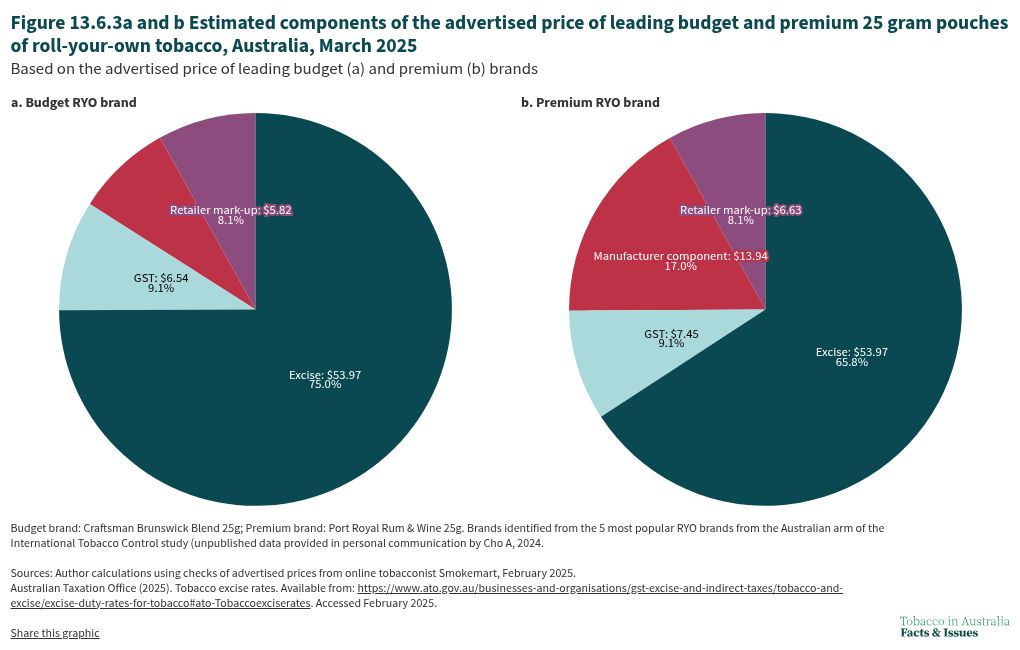
The easiest way to understand the cost is to see it. Imagine the price of a typical premium pack of 25 cigarettes is $59. Let’s slice it up like a pie.
Dissecting the Four Main Cost Components
Your $59 is not just for tobacco. It’s a combination of four distinct parts:
-
Government Taxes (Excise + GST): The largest slice by far.
-
Manufacturer & Wholesaler Costs: The cost to produce, import, and distribute the product.
-
Retailer Margin: The profit the store makes.
-
Actual Tobacco & Manufacturing Cost: The smallest slice of all.
The Shocking Cigarette Tax Percentage Revealed
Now, let’s put some numbers to those slices. The results are startling and paint a clear picture of the cigarette price breakdown.
The Dominant Slice: The Role of the Australia Tax on Cigarettes
In our $59 pack example, the combined Australia tax on cigarettes (Excise and GST) accounts for approximately $43. This means the cigarette tax percentage is a staggering 73% of the total price you pay. For every dollar you spend, about 73 cents goes to the tax office.
Product Cost vs. Tax: A Startling Comparison
This means that the other components are much smaller. The combined cost of the actual tobacco, manufacturing, shipping, marketing, and the profit for both the wholesaler and the retailer is only about $16. The tax component is nearly three times larger than the entire business cost of the product.
Why This Matters: Finding Value in the Smallest Slice
Understanding this breakdown is empowering. It shows you where the potential for savings really is. You cannot avoid the tax, but you can be smarter about the other parts of the price.
Where Your Savings Potential Truly Lies
Since the tax is a fixed, massive cost, the only room for price competition is in the “Retailer Margin” slice of the pie. A retailer with lower operating costs can afford to take a smaller margin. This directly translates to a lower final price for you.
The Advantage of Low-Overhead Retailers
This is where online stores shine. Without the high costs of a physical retail shop, online platforms can operate on a leaner margin. This allows them to offer a more competitive price on the exact same tax-paid, authentic product. They are attacking the one part of the price that has flexibility.
Conclusion: Making Smart Choices in a High-Tax Market
The next time you purchase cigarettes, remember the pie chart. The vast majority of the price is a tax you cannot change. The real choice you have is how much you pay for that small remaining slice. By understanding the tobacco tax breakdown, you can see that finding a retailer with a lower margin is the key to real savings. In a high-tax market, making smart choices means finding the best value, not just accepting the first price you see. To find a retailer focused on value, you can start by exploring our full product range.
Frequently Asked Questions (FAQ)
Is the cigarette tax percentage the same for all brands?
Yes, the excise duty is calculated “per stick,” so the tax amount is the same for a cheap cigarette and a premium one. This means the tax makes up an even higher percentage of the final price for budget brands.
Where does all the money from the tobacco tax breakdown go?
The revenue collected from tobacco taxes goes into the Australian Government’s consolidated revenue. It is used to fund all government services, including public health, infrastructure, and education.
Does the tax percentage apply to rolling tobacco as well?
Yes. Rolling tobacco is taxed by weight (per kilogram). The tax is structured to be broadly equivalent to the tax on factory-made cigarettes, so a very high percentage of its price is also tax.
How can I calculate the tax on my own pack of cigarettes?
You can visit the Australian Taxation Office (ATO) website to find the current excise duty rate per stick. Multiply that by the number of cigarettes in your pack, and then add 10% GST to get a close estimate of the total tax. You’ll see it makes up the bulk of the cigarette price breakdown.